

Kế hoạch bài dạy Tiếng Anh Lớp 3 - Tuần 25 - Unit 15: At the dining table - Năm học 2024-2025 - Lê Thị Huyền
 32 trang
16/12/2025
370
32 trang
16/12/2025
370
Bạn đang xem 20 trang mẫu của tài liệu "Kế hoạch bài dạy Tiếng Anh Lớp 3 - Tuần 25 - Unit 15: At the dining table - Năm học 2024-2025 - Lê Thị Huyền", để tải tài liệu gốc về máy hãy click vào nút Download ở trên.
Tóm tắt nội dung tài liệu: Kế hoạch bài dạy Tiếng Anh Lớp 3 - Tuần 25 - Unit 15: At the dining table - Năm học 2024-2025 - Lê Thị Huyền
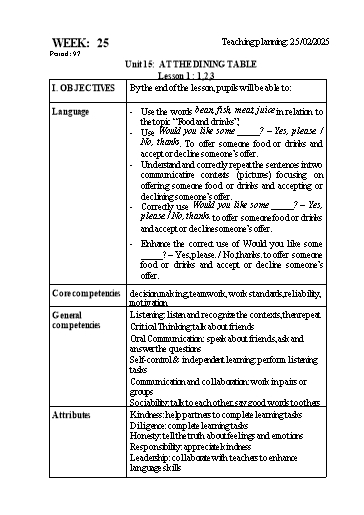
 WEEK: 25 Teaching planning: 25/02/2025
 P Period: 97
 Unit 15: AT THE DINING TABLE
 Lesson 1 : 1,2,3
I. OBJECTIVES By the end of the lesson, pupils will be able to:
Language - Use the words bean, fish, meat, juice in relation to
 the topic “Food and drinks”;
 - Use Would you like some _____? – Yes, please. /
 No, thanks. To offer someone food or drinks and
 accept or decline someone’s offer.
 - Understand and correctly repeat the sentences in two
 communicative contexts (pictures) focusing on
 offering someone food or drinks and accepting or
 declining someone’s offer.
 - Correctly use Would you like some _____? – Yes,
 please. / No, thanks. to offer someone food or drinks
 and accept or decline someone’s offer.
 - Enhance the correct use of Would you like some
 _____? – Yes, please. / No, thanks. to offer someone
 food or drinks and accept or decline someone’s
 offer.
Core competencies decision making, teamwork, work standards, reliability,
 motivation
General Listening: listen and recognize the contexts, then repeat
competencies Critical Thinking: talk about friends
 Oral Communication: speak about friends, ask and
 answer the questions
 Self-control & independent learning: perform listening
 tasks
 Communication and collaboration: work in pairs or
 groups
 Sociability: talk to each other, say good words to others
Attributes Kindness: help partners to complete learning tasks
 Diligence: complete learning tasks
 Honesty: tell the truth about feelings and emotions
 Responsibility: appreciate kindness
 Leadership: collaborate with teachers to enhance
 language skills II. RESOURCES AND MATERIAL:
 - Student’s book Page 30
 - Audio Tracks 42, 43
 - Teacher’s guide Pages 183, 184, 185
 - Website sachmem.vn
 - Flashcards/pictures and posters (Unit 15)
 - Computer, projector
III. PROCEDURE Warm-up and review – Look, listen and repeat –
 Listen, point and say – Let’s talk – Fun corner and
 wrap up
 Procedure Teacher’s activities Pupils’ activities Note
Warm-up and review: 5 minutes
 Greet the class.
 Option 1: Sing the Whole class
 song in Unit 14,
 Lesson 1.
 - Ask pupils to sing
 the song.
 Group work
 - Invite some of
 them to come to
 the board to role
 play, the rest of
 the pupils will
 sing. Individual work/ Group
 work
 Option 2: Chant and
 do activities (Unit 14,
 Lesson 3).
 - Ask pupils to
 chant and do the
 actions in Unit 14,
 Lesson 3 in
 groups.
 - Give points for
 the groups and
 encourage them.
 Option 3:
 - Play game in the powerpoint Unit
 15 – lesson 1 –
 period 1
 - Divide the class
 into 2 teams to
 play “Colorful
 flowers 1”.
 - Each team
 chooses one
 flower to go to the
 question.
 - Have pupils look,
 read and choose
 the right option.
 - Back to the menu
 for pupils to
 choose another
 question.
 - Pupils continue
 their turns until
 there are not any
 flowers left.
 - The one who gets
 the most points is
 the winner.
EXPLORATION
Activity 1. Look, listen and repeat. 8 minutes
a. Goal: To understand and correctly repeat the sentences in
 two communicative contexts (pictures) focusing on
 offering someone food or drinks and accepting or
 declining someone’s offer
b. Input: – Context a: Mother: Would you like some rice?
 Nam : Yes, please.
 – Context b: Father: Would you like some juice?
 Nam: No, thanks.
c. Outcome: Pupils can understand and correctly repeat the
 sentences in two communicative contexts
 (pictures) focused on offering someone food or
 drinks and accepting or declining someone’s offer. d. Procedure: Step 1: Have pupils Whole class
 look at Pictures a and
 b and identify the Whole class
 characters in the
 pictures.
 Step 2: Ask pupils to
 Whole class
 look at Picture a. Play
 the recording for / Individual work
 them to listen. Play Pair work
 the recording again,
 sentence by sentence, Individual work
 for pupils to listen
 and repeat. Follow
 the same procedure
 with Picture b.
 Correct their
 pronunciation where
 necessary.
 Step 3: Play the
 recording again for
 pupils to listen and
 repeat in chorus
 sentence by sentence.
 Step 4: Invite a few
 pairs to the front of
 the classroom to
 listen and repeat the
 sentences in the
 recording.
 Step 5: : Draw their
 attention to the
 question Would you
 like some rice? and
 the answer Yes,
 please. and Would
 you like some juice?
 and the answer No,
 thanks. Tell pupils
 that they are the
 questions and the
 answers about
 offering someone
 food or drinks and
 accepting or declining someone’s offer.
KNOWLEDGE CONSTRUCTION
Activity 2. Listen, point and say. 9 minutes
a. Goal: To correctly use Would you like some _____? –
 Yes, please. / No, thanks. to offer someone food or
 drinks and accept or decline someone’s offer
b. Input: – Picture cues:
 a. a plate of beans b. a plate of fish
 c. a plate of meat d. a bottle of juice
 – Speech bubbles: Would you like some _____? –
 Yes, please. / No, thanks.
 Audio script:
 a. beans / yes b. fish / no c. meat / yes
 d. juice / no
 A: Would you like some beans?
 B: Yes, please.
 A: Would you like some fish?
 B: No, thanks.
c. Outcome: Pupils can correctly say the words and use Would
 you like some _____? – Yes, please. / No, thanks.
 to offer someone food or drinks and accept or
 decline someone’s offer.
d. Procedure: Step 1: Have pupils Whole class/ Individual
 look at the pictures work
 and elicit the names Whole class/ Individual
 of the food and drink. work
 Have the class repeat
 the words a few
 times.
 Whole class/ Individual
 Step 2: Have pupils
 work
 point at Picture a,
 listen to the recording
 and repeat the words Pair work
 (beans/ yes). Follow
 the same procedure
 with the other three
 Pair work
 pictures. Have the class repeat the
words a few times.
Step 3: Point at Group work
Picture a and have
pupils listen and
repeat after the
recording (Would you
like some beans? –
Yes, please.). Point at
Picture c and have
pupils listen and
repeat
after the recording
(Would you like some
meat? – No, thanks.).
Step 4: Have pairs
practise asking and
answering questions
Would you like some
______? Yes, please./
No, thanks. with
Pictures b and d.
Step 5: Invite a few
pairs to point at the
pictures and say the
questions and
answers in front of
the class.
Game: Slap the
board.
- Divide the class
 into four teams.
- Stick the pictures
 of activities on the
 board.
- Teacher says a
 sentence, a pupil
 from each team
 has to point/slap
 the right picture
 and says the sentence again.
 The one says
 faster will get
 points.
PRACTICE
Activity 3. Let’s talk. 8 minutes
a. Goal: To enhance the correct use of Would you like some
 _____? – Yes, please. / No, thanks. to offer
 someone food or drinks and accept or decline
 someone’s offer in a freer context
b. Input: – Picture cue: A family at the dining table: father,
 mother, their son and daughter are having lunch.
 There is some food and drinks on the table such as
 rice, fish, beans and juice.
 – Speech bubbles: Would you like some _____? –
 Yes, / No, some _____.
c. Outcome: Pupils can enhance the correct use of Would you
 like some _____? – Yes, please. / No, thanks. to
 offer someone food or drinks and accept or decline
 someone’s offer in a freer context.
d. Procedure: Step 1: Draw pupils’ Whole class/ Individual
 attention to the work
 picture. Ask Group work
 questions to help
 them identify the
 Pair work
 context (see Input).
 Step 2: Elicit the
 missing words in the Pair work
 speech bubble and
 write them on the
 board. Get pupils to Whole class
 say the completed
 /Individual work
 sentence. Correct
 their pronunciation
 where necessary.
 Step 3: Put pupils
 into pairs and
 encourage them to
 offer someone food
 or drinks and accept
 or decline someone’s offer.
 Step 4: Invite some
 pairs to the front of
 the class to perform
 the conversations.
 Preparation for the
 project:
 Tell pupils about the
 project on page 35.
 Ask them to do it in
 class by doing a
 survey with
 classmates
 (interviewing) and
 report the results to
 the class at Project
 time about food and
 drinks they would
 like to eat and drink.
Fun corner and wrap up: 5 minutes
 Option 1:
 Using sachmem.vn, Whole class
 activity 1: Look,
 listen and repeat or
 activity 2: Listen,
 point and say, have
 pupils look at the Group work
 phrases or sentences
 in the pictures and
 repeat after the
 recording.
 Option 2:
 Game: Sentence Group work
 Puzzle
 - Divide the class
 into groups of
 four.
 - Give each group a
 sentence that is
 broken/cut into pieces.
 - Ask them to
 arrange the words
 to make a
 complete
 sentence, then
 read it aloud.
 - The group that
 makes it first will
 be the winner.
 Option 3:
 - Play a game in the
 powerpoint for
 Unit 15 – lesson 1
 – period 1.
 - Divide the class
 into 2 teams to
 play “ Colourful
 flowers 2”.
 - Each team
 chooses one
 flower to go to the
 question.
 - Have pupils look,
 read and choose
 the right option.
 - Back to the menu
 for pupils to
 choose another
 question.
 - Pupils continue
 their turns until
 there are not any
 flowers left.
 - The one who gets
 the most points is
 the winner.
Adjustment
................................................................................................................................. Teaching planning: 25/02/2025
 Period:98
 Unit 15: AT THE DINING TABLE
 Lesson 1: 4,5,6
I. OBJECTIVES By the end of the lesson, pupils will be able to:
Language - Use the words bean, fish, meat, juice in relation to
 the topic “Food and drinks”;
 - Use Would you like some _____? – Yes, please. /
 No, thanks. To offer someone food or drinks and
 accept or decline someone’s offer.
 - Listen to and understand two communicative
 contexts about food and drinks.
 - Look, complete and read six target sentences with
 the help of picture cues.
 - Sing the song Would you like some ? with the
 correct pronunciation, rhythm and melody.
Core competencies decision making, teamwork, work standards, reliability,
 motivation, adaptability, problem-solving
General Listening: listen and recognize the contexts focus on
competencies introduce someone, then repeat
 Critical Thinking: talk about friends
 Oral Communication: speak about friends, ask and
 answer the questions
 Self-control & independent learning: perform listening
 tasks
 Communication and collaboration: work in pairs or
 groups
 Sociability: talk to each other, say good words to others
Attributes Kindness: help partners to complete learning tasks
 Diligence: complete learning tasks
 Honesty: tell the truth about feelings and emotions
 Responsibility: appreciate kindness
 Leadership: collaborate with teachers to enhance
 language skills
II. RESOURCES AND MATERIAL: - Student’s book Page 31
 - Audio Tracks 44, 45
 - Teacher’s guide Pages 185, 186
 - Website sachmem.vn
 - Flashcards/pictures and posters (Unit 15)
 - Computer, projector
III. PROCEDURE Warm-up and review – Listen and tick – Look,
 complete and read – Let’s sing – Fun corner and
 wrap up
 Teaching and learning Note
 Procedure Classroom management
 activities
Warm-up and review: 5 minutes
 Greet the class.
 Option 1: Sing the song in Whole class
 Unit 14, Lesson 1.
 - Ask pupils to sing the
 song.
 - Invite some of them to Group work
 come to the board to role
 play, the rest of the
 pupils will sing.
 Option 2: Chant and do
 activities (Unit 14, Lesson 3).
 Group work
 Ask pupils to chant and
 - / Individual work
 do the actions in Unit 14,
 Lesson 3 in groups.
 - Give points for the
 groups and encourage
 them.
 Option 3:
 - Play games in the
 powerpoint Unit 15 –
 lesson 1 – period 2.
 - Divide the class into 2
 teams to play “ Fruit
 Juice”.
 - Each team chooses one jar of juice to go to the
 question.
 - Have pupils look, read
 and choose the right
 option.
 - Back to the menu for
 pupils to choose another
 question.
 - Pupils continue their
 turn until there are not
 any jars of juice left.
 - The one who gets the
 most points is the winner.
PRACTICE
Activity 4. Listen and tick. 8 minutes
a. Goal: To listen to and understand two communicative contexts
 about food and drinks and tick the correct pictures
b. Input: – Picture cues:
 1a. a bowl of rice 1b. a plate of fish
 2a. a plate of meat 2b. a glass of juice
 Audio script:
 1. A: Would you like some fish? B: Yes, please.
 2. A: Would you like some juice? B: Yes, please.
c. Outcome: Pupils can listen to and understand two communicative
 contexts about food and drinks and tick the correct
 pictures.
 Key: 1. b 2. b
d. Procedure: Step 1: Draw pupil’s attention Whole class
 to Pictures 1a and 1b. Elicit
 the names of the food. Play
 Whole class
 the recording for Question 1.
 Step 2: Play the recording
 again for pupils to do the Whole class
 task. Play the recording a Whole class/ Pair work
 third time to give pupils
 another listening opportunity.
 Whole class/ Individual
 Step 3: Repeat Steps 1 and 2
 work
 for Pictures 2a and 2b.
 Step 4: Tell pupils to swap
 books with a partner, then
 check answers together as a class. Write the correct
 answers on the board. Play
 the recording again for the
 pupils to double-check their
 answers.
 Extension: If time allows,
 play the recording sentence
 by sentence for the class to
 listen and repeat in chorus.
 Correct their pronunciation
 where necessary.
PRACTICE
Activity 5. Look, complete and read. 9 minutes
a. Goal: To look, complete and read six target sentences with the
 help of picture cues
b. Input: – Picture cues
 – Six sentences / exchangers to complete
c. Outcome: Pupils can complete two sentences and two dialogues
 with the help of picture cues.
 Key: 1. rice 2. beans 3. fish; please
 4. juice; No
d. Procedure: Step 1: Have pupils look at Whole class/ Individual
 the pictures. Have them work
 identify the names of food Whole class/ Individual
 and drinks in the pictures. work
 Step 2: Have pupils look at
 the incomplete sentences. Whole class/ Individual
 Draw their attention to the work
 missing words in the
 questions and answers.
 Step 3: Model with Picture 1.
 Have pupils look at the first Individual work
 question. Ask them what
 word is missing in the Individual work
 question (rice). Then have / Pair work
 them complete the question
 (Would you like some rice?).
 Group work
 Step 4: Follow the same
 procedure with Pictures 2, 3
 and 4. Draw the pupils'
 attention to the gaps in the
 questions and answers in Pictures 2, 3 and 4.
 Step 5: Have pupils complete
 the gaps in the questions and
 answers individually and ask
 a few pairs to read them
 aloud.
 Game: Slap the board.
 - Divide the class into four
 teams.
 - Stick the pictures of
 activities on the board.
 - Teacher says a sentence,
 a pupil from each team
 has to point/slap the
 right picture and says
 the sentence again. The
 one who says faster will
 get points.
PRACTICE
Activity 6. Let’s sing. 8 minutes
a. Goal: To sing the song Would you like some ? with the
 correct pronunciation
b. Input: The lyrics and the recording of the song Would you like
 some ?
c. Outcome: Pupils can sing the song Would you like some ? with
 the correct melody and pronunciation.
d. Procedure: Step 1: Draw pupils’ attention Whole class/ Individual
 to the title and lyrics of the work
 song. Model the title and
 lyrics line by line for pupils to Whole class
 repeat. Encourage them to
 point at the characters’
 picture to reinforce their
 understanding. Whole class
 Step 2: Play the recording all /Individual work
 the way through for pupils to
 listen to the whole song. Whole class
 Encourage them to listen
 carefully to the pronunciation
 and the melody. Group work
 Step 3: Play the recording line by line for pupils to listen
 and repeat. Correct their
 pronunciation where
 Whole class
 necessary.
 / Individual work
 Step 4: Play the recording all
 the way through for pupils to
 sing along.
 Step 5: Introduce actions for
 pupils to do while singing
 along with the recording.
 Extension: Put pupils into
 groups to make up actions for
 the song. Invite some groups
 to the front of the class to
 perform while the rest of the
 class sings and/or claps along.
 Game:
 Matching game
 - Using pictures and
 flashcards, get 3 pupils to
 hold the pictures and 3
 more to hold the
 sentences.
 - Ask them to find and
 match.
 - Praise the ones who finish
 the matching.
 - Then ask the class to look
 and say aloud.
Fun corner and wrap up: 5 minutes
 Option 1:
 Game: Interview your Whole class
 friend(s).
 Each pupil gets 1 sheet of
 paper from the teacher. They
 fill in the information about
 their favourite food and drink.
 Then they can move around
 the class to ask and answer
 the questions to know more Group work
 about their friends’ favourite taste.
 Option 2:
 Game: Sentence Puzzle
 - Divide the class into
 groups of four.
 - Give each group a Whole class
 sentence that is broken/cut
 into pieces. Ask them to
 arrange the words to make
 a complete sentence, then
 read it aloud.
 - The group that makes it
 first will be the winner.
 Option 3:
 - Play the game in the
 powerpoint for Unit 15 –
 lesson 1 – period 2.
 - Divide the class into 2
 teams to play “ Yummy”.
 - Each team chooses one
 bowl to go to the question.
 - Have pupils look, read and
 choose the right option.
 - Back to the menu for
 pupils to choose another
 question.
 - Pupils continue their turns
 until there are not any
 bowls left.
 - The team who gets the
 most points is the winner.
Adjustment
.................................................................................................................................
.................................................................................................................................
.................................................................................................................................
.................................................................................................................................
 ________________________________________________________________ WEEK: 25 Teaching planning: 26/02/2025
 Period: 99
 Unit 15: AT THE DINING TABLE
 Lesson 2 : 1,2,3
 I. By the end of the lesson, pupils will be able to:
 OBJECTIVES
 Language - Use the words bean, fish, meat, juice, egg, chicken,
 water, milk and rice in relation to the topic “Food and
 drinks”;
 - Use What would you like to eat/drink? – I’d like some,
 please. To ask and answer questions about food and
 drinks;
 - understand and correctly repeat the sentences in two
 communicative contexts (pictures). focusing on what
 someone would like to eat or drink.
 - correctly use What would you like to eat / drink? - I’d like
 some ____, please. to ask and answer questions about
 what someone would like to eat or drink.
 - enhance the correct use of What would you like to eat /
 drink? – I’d like some ____, please. to ask and answer
 questions about what someone would like to eat or drink.
 Core communication, planning and organization, stress tolerance,
 competencies and initiative.
 General Listening: listen and recognize someone, then repeat
 competencies Critical Thinking: talk about someone
 Oral Communication: speak about someone, ask and answer
 the question
 Written Communication: practice writing about school
 things
 Self-control & independent learning: perform listening tasks
 Communication and collaboration: work in pairs or groups
 Problem-solving and creativity: answer comprehension
 questions after reading the story
 Sociability: talk to each other, say good words to others
 Attributes Kindness: help partners to complete learning tasks
 Diligence: complete learning tasks
 Honesty: tell the truth about feelings and emotions
 Responsibility: appreciate kindness Leadership: collaborate with teachers to enhance language
 skills
 Secure and Organized: keep school things in the right ways
II. RESOURCES AND MATERIAL:
 - Student’s book Page 32
 - Audio Tracks 46, 47
 - Teacher’s guide Pages 187, 188
 - Website sachmem.vn
 - Flashcards/pictures and posters (Unit 15)
 - Computer, projector
III. Warm-up and review – Look, listen and repeat – Listen,
PROCEDURE point and say – Let’s talk – Fun corner and wrap up
 Procedure Teacher’s activities Pupils’ activities Note
Warm-up and review: 5 minutes
 Greet the class.
 Option 1: Sing the song in Unit Whole class
 15, Lesson 1.
 - Ask pupils to sing the song.
 - Invite some of them to come
 to the board to role play, the Group work
 rest of the pupils will sing.
 Option 2: Play game Board
 Race!
 - Divide the class into two
 teams.
 - Give each team a colored
 marker.
 - Draw a line down the
 middle of the board and
 write a topic at the top.
 - Have pupils write as many
 words related to the topic in Group work
 a relay. / Individual work
 - The first pupil will write the
 first word and pass the
 colored marker to the one
 next in line. - One point for each correct
 word.
 - Unreadable or misspelled
 words are not counted.
 Option 3:
 - Play games in the
 powerpoint Unit 15 – lesson
 2 – period 3.
 - Divide the class into 2 teams
 to play “ What’s missing”.
 - Each team chooses one jar
 of juice to go to the
 question.
 - Have pupils find out what is
 missing and say out loud the
 name of the food.
 - Back to the menu for pupils
 to choose another question.
 - Pupils continue their turns
 until there are not any jars of
 juice left.
 - The team who gets the most
 points is the winner.
EXPLORATION
Activity 1. Look, listen and repeat. 8 minutes
a. Goal: To understand and correctly repeat the sentences in two
 communicative contexts (pictures). focusing on what
 someone would like to eat or drink
b. Input: – Context a: Staff: What would you like to eat?
 Nam: I’d like some bread, please.
 – Context b: Staff: What would you like to drink?
 Mai: I’d like some milk, please.
c. Outcome: Pupils can understand and correctly repeat the sentences
 in two communicative contexts (pictures) focus on what
 someone would like to eat or drink.
d. Procedure: Step 1: Have pupils look at Whole class
 Pictures a and b and identify the
 characters and food and drinks Whole class
 in the pictures.
 Step 2: Ask pupils to look at Picture a. Play the recording for Whole class/
 them to listen. Play the Individual work
 recording again, sentence by Pair work
 sentence, for pupils to listen
 and repeat. Follow the same
 procedure with Picture b. Individual work
 Correct their pronunciation
 where necessary.
 Step 3: Play the recording
 again for pupils to listen and
 repeat in chorus sentence by
 sentence.
 Step 4: Invite a few pairs to the
 front of the classroom to listen
 and repeat the sentences in the
 recording.
 Step 5: Draw their attention to
 the question What would you
 like to eat? and the answer I’d
 like some bread, please. and
 What would you like to drink?
 and the answer I’d like some
 milk, please. Tell pupils that
 they are the questions and the
 answers about what Nam and
 Mai would like to eat and drink.
KNOWLEDGE CONSTRUCTION
Activity 2. Listen, point and say. 9 minutes
a. Goal: To correctly use What would you like to eat / drink? - I’d
 like some ____, please. to ask and answer questions
 about what someone would like to eat or drink
b. Input: – Picture cues: a. some eggs b. some
 chicken
 c. a bottle of water d. a box of
 milk
 – Speech bubbles: What would you like to eat / drink? –
 I’d like some ____, please.
 Audio script:
 a. eggs b. chicken c. water d. milk
 A: What would you like to eat?
 B: I’d like some eggs, please.
 A: What would you like to drink?
File đính kèm:
- ke_hoach_bai_day_tieng_anh_lop_3_tuan_25_unit_15_at_the_dini.docx
