

Kế hoạch bài dạy Tiếng Anh Lớp 5 - Tuần 24 - Unit 14: Staying healthy - Năm học 2024-2025 - Lê Thị Khang
 11 trang
09/01/2026
340
11 trang
09/01/2026
340
Bạn đang xem tài liệu "Kế hoạch bài dạy Tiếng Anh Lớp 5 - Tuần 24 - Unit 14: Staying healthy - Năm học 2024-2025 - Lê Thị Khang", để tải tài liệu gốc về máy hãy click vào nút Download ở trên.
Tóm tắt nội dung tài liệu: Kế hoạch bài dạy Tiếng Anh Lớp 5 - Tuần 24 - Unit 14: Staying healthy - Năm học 2024-2025 - Lê Thị Khang
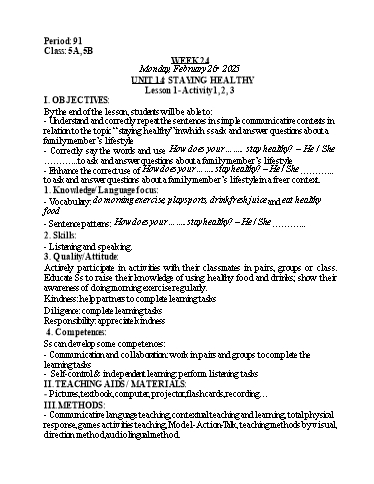
Period: 91
Class: 5A, 5B
 WEEK 24
 Monday, February 26th 2025
 UNIT 14: STAYING HEALTHY
 Lesson 1- Activity 1, 2, 3
I. OBJECTIVES:
By the end of the lesson, students will be able to:
- Understand and correctly repeat the sentences in simple communicative contexts in
relation to the topic “staying healthy” in which ss ask and answer questions about a
family member’s lifestyle
- Correctly say the words and use How does your .. stay healthy? – He / She
 ... to ask and answer questions about a family member’s lifestyle
- Enhance the correct use of How does your .. stay healthy? – He / She ...
to ask and answer questions about a family member’s lifestyle in a freer context.
1. Knowledge/ Language focus:
- Vocabulary: do morning exercise, play sports, drink fresh juice and eat healthy
food
- Sentence patterns: How does your .. stay healthy? – He / She ...
2. Skills:
- Listening and speaking.
3. Quality /Attitude:
Actively participate in activities with their classmates in pairs, groups or class.
Educate Ss to raise their knowledge of using healthy food and drinks; show their
awareness of doing morning exercise regularly.
Kindness: help partners to complete learning tasks
Diligence: complete learning tasks
Responsibility: appreciate kindness
 4. Competences:
Ss can develop some competences:
- Communication and collaboration: work in pairs and groups to complete the
learning tasks
- Self-control & independent learning: perform listening tasks
II. TEACHING AIDS / MATERIALS:
- Pictures, textbook, computer, projector, flashcards, recording
III. METHODS:
- Communicative language teaching, contextual teaching and learning, total physical
response, games activities teaching, Model-Action-Talk, teaching methods by visual,
direction method, audiolingual method.
 IV. PROCEDURE:
 Teacher’s activities Students’ activities
 1.Warm- up:
 -Play game: “Hot potatoes”
 - Teacher plays the music. -Ss listen.
 - Ss pass the ball.
 -Teacher stops music suddenly. Have the -Ss play game.
 student with a ball talk about their menu for
 the next birthday party.
 - Repeat the game several times.
 -Say “Open your book page 24 and look at -Ss open their book.
 Unit 14, Lesson 1- Activity 1, 2, 3”
 2. New lesson
 Activity 1. -1. Look, listen and repeat:
 -Set the scene: we are going to listen to the -Look at the picture and listen.
 dialogue in which the characters ask and
 answer questions about a family member’s
 lifestyle
 - Ask students to look at the picture in the
 book and identify the characters in the -Ss look at the picture and identify
 pictures: the characters in the pictures.
 + Who is he / she?
 + What are they talking about?
 - Play the recording again for Ss to listen -Ss listen and repeat sentence by
 and repeat in chorus, sentence by sentence. sentence.
 -Divide the class into two groups to read the -Ss read in groups.
 dialogue.
 -Have time for ss to point and read in pairs. -Ss point and read in pairs.
 - Invite some pairs to practise in front of the -Ss practise in front of the class.
 class.
 - T get feedback.
 Activity 2 - 2. Listen, point and say:
 - Teach vocabulary: do morning exercise, -Ss listen and repeat new words, then
 play sports, drink fresh juice and eat healthy write on their notebook
 food (Using pictures)
 -Check vocabulary: matching -Ss play game.
 -Look at the picture and answer.
 - Have Ss look at pictures. Ask ss to look at
Pictures a, b, c, and d and identify the
lifestyle of each character.
- Sentence Pattern:
How does your .. stay healthy?
–> He / She ...
-Play the recording for Ss to listen to and -Ss listen and repeat.
repeat the words under the pictures in
chorus and individually until they feel
confident. -A student model.
- T models with a student. Then asks Ss
practice in pairs -Ss practise in pairs.
- Have time for Ss to practise in pairs and
corrects pronunciation if necessary. -Ss practise in front of the class.
- Invite ss to ask and answer in front of the
class.
- T gets feedback
Activity 3. Let’s talk : -Ss look and listen.
-Tell Ss that they are going to practise more
with their friends to ask and answer
 -Ss repeat.
- Elicit the words to fill in the gaps and have
 -Ss practise in pairs.
ss to repeat.
-Have time for ss to practise in pairs. -Ss act out in front of the class.
-Call some pairs to act out in front of the
class.
- T corrects pronunciation, if necessary.
-T gets feedback.
3. Homelink. -Ss listen.
- Practice more at home. -Ss listen.
- Prepare for the next lesson.
 Period: 92
Class: 5A, 5B
 Tuesday, February 27th 2025
 UNIT 14: STAYING HEALTHY
 Lesson 1- Activity 4, 5, 6
I. OBJECTIVES:
By the end of the lesson, students will be able to:
- Listen to and understand four communicative contexts in which speakers ask and
answer questions about a family member’s lifestyle and match the characters with
the activities they do to stay healthy;
- Complete four gapped exchanges with the help of picture cues;
- Listen to and complete the song Staying healthy and sing it with the correct
pronunciation, rhythm and melody.
1. Knowledge/ Language focus:
- Vocabulary: review
- Sentence patterns: review
2. Skills:
- Listening, writing and reading
3. Quality /Attitude:
Actively participate in activities with their classmates in pairs, groups or class.
Educate Ss to raise their knowledge of using healthy food and drink; show their
awareness of doing morning exercise regularly.
 Kindness: help partners to complete learning tasks
 Diligence: complete learning tasks
 Responsibility: appreciate kindness
Leadership: collaborate with teachers to enhance language skills
4. Competences:
SS can develop some competences:
- Communication and collaboration: work in pairs and groups to complete the
learning tasks
- Self-control & independent learning: perform listening tasks
II. TEACHING AIDS / MATERIALS:
- Pictures, textbook, computer, projector, flashcards, flashcards, recording
III. METHODS:
- Communicative language teaching, contextual teaching and learning, total physical
response, games activities teaching, Model-Action-Talk, teaching methods by visual,
direction method, audiolingual method.
IV. PROCEDURE:
 Teacher’s activities Students’ activities
1.Warm- up: Play game: Musical cards
 - Stick the cards on the board. Ask Ss to - Ss listen
say the words related to the cards.
- Hand out the cards to different pupils
around the class.
- Play the song “Staying healthy” (Unit 14). -Ss play game.
Ask Ss to pass the cards to the Ss next to
them while the music is playing.
- Stop the music suddenly. Invite a pupil to
ask the question “How does he stay
healthy?”. Ask a student who is holding the
card to answer the question, e.g. He plays
sports.
- Play the music again and repeat the
activity.
- Ask Ss to check their friends’
pronunciation.
-Say “Open your book page 25 and look at -Ss open their book.
lesson 3 – Activity 4, 5, 6”
2. New lesson
Activity 1. - 4. Listen and match.
-Aks ss to look at the pitures and identify -Look at the picture, listen and
characters and the activities in the pictures. answer.
Point at the pictures respectively to explain
the context.
- Play the recording for ss to do the task.
- Get Ss to swap with a partner.
- Play the recording again to check answers
together as a class.
-Ask ss to write their answers on the board
and correct their answers. -Ss listen and do the task.
- Play the recording all the way through for -Ss swap.
Ss to double-check all the answers. -Ss listen and repeat.
* Key: 1. a 2. c 3. b 4. d
 Activity 2 - 5. Read and complete:
- Get Ss to look at the pictures. Get them to -Ss write their answers
 identify a family member’s lifestyle of the
character in each picture. -Ss check the answers.
- Have Ss look at the four incomplete
sentences and guess the missing word. -Look at the picture and identify.
- Model with a sentence.
- Have Ss complete the sentences
individually.
-Ask ss to write their answers on the board
and correct their answers.
-Ask a few Ss to read the correct answers in
front of the class.
-T gets feedback.
* Key: 1. juice
2. morning exercise -Ss look and listen.
3. plays sports; volleyball
4. How does; food -Ss do the task.
Activity 3. -6. Listen, complete and sing.
- Tell Ss the aim of the activity: They listen -Ss write their answers.
to the song, fill in the gaps in the lyrics and
sing it with the correct pronunciation, -Ss read in front of the class.
rhythm and melody.
- Have Ss read the lyrics and guess the -Ss look and listen.
word(s) to fill in the gaps with the help of
pictures.
- Have them listen to the song and fill in the
gaps. Play the recording of the gapped
sentences twice for Ss to fill in if necessary.
- Play the recording and let them listen to
and practise singing the song, line by line,
until they feel confident.
- Invite a few groups to the front of the class
to sing the song. The class may sing along
and clap to reinforce the activity. -Ss listen and do the task.
*Key: 1. morning exercise -Ss listen and repeat line by line.
2. sports 3. fruit
3. Homelink . -Ss practise singing and doing
- Practice more at home. actions in pairs.
- Prepare for the next lesson.
 -Ss perform in front of the class.
 -Ss listen.
 -Ss listen.
Period: 93
Class: 4A, 4B, 4C
 Thursday, February 27th 2025
 UNIT 14: STAYING HEALTHY
 Lesson 2- Activity 1, 2, 3
I. OBJECTIVES:
By the end of the lesson, students will be able to:
- Understand and correctly repeat the sentences in simple communicative contexts in
relation to the topic “staying healthy” in which ss ask and answer questions about
the frequency of an activity.
- Correctly say the words and use How often does he / she ..? - ..to
ask and answer questions about the frequency of an activity;
- Enhance the correct use of How often does he / she ..? - ..to ask and
answer questions about the frequency of an activity in a freer context.
1. Knowledge/ Language focus:
- Vocabulary: once a week, twice a week, three times a week and every day
- Sentence patterns: How often does he / she ..? - ..
2. Skills:speaking.
3. Quality /Attitude:
Actively participate in activities with their classmates in pairs, groups or class.
Educate Ss to know about the frequency of an activity.
Kindness: help partners to complete learning tasks
Diligence: complete learning tasks
Responsibility: appreciate kindness
 4. Competences:
SS can develop some competences:
- Communication and collaboration: work in pairs and groups to complete the
learning tasks
- Self-control & independent learning: perform listening tasks
II. TEACHING AIDS / MATERIALS:
- Pictures, textbook, computer, projector, flashcards, recording
III. METHODS:
- Communicative language teaching, contextual teaching and learning, total physical
response, games activities teaching, Model-Action-Talk, teaching methods by visual,
direction method, audiolingual method.
IV. PROCEDURE:
 Teacher’s activities Students’ activities
 1.Warm- up: 5’
 Game: Slap the board
*Aims: to help ss to be happy to learn new
lesson.
*Teaching techniques
- techniques in teaching playing game.
*Procedure:
- Prepare pictures of different types of -Ss look and listen.
food and drinks.
- Divide the class into 3 teams. Number Ss
in each team.
- Focus Ss on the sentences and pictures on - Ss play game.
the screen.
- Call out a number and ask student to slap
the correct answer on the board.
- Check the answer with the whole class.
-Say “Open your book page 26 and look at -Ss open their book.
Unit 14, Lesson 2 – Activity 1, 2, 3”
2. New lesson
Activity 1. -1.Look, listen and repeat:9’
*Aims: To understand and correctly repeat
the sentences in two communicative
contexts (pictures) focusing on asking and
answering questions about the frequency
of an activity.
*Context:
- Context a: Ben and Mai at a swimming
pool talking about Mai’s brother
Ben: Your brother’s a strong swimmer.
Mai: Yes, he is. He wants to join the
swimming team at his school.
- Context b: Ben asking Mai about her
brother’s habit
Ben: That’s great! How often does he
swim?
Mai: Every day. Even at the weekend.
*Teaching techniques:
- techniques in teaching listening and
speaking,
- individual, pairworks, ask and answer
- using flashcards, recording, pictures
*Procedure:
-Set the scene: we are going to listen to the
dialogue in which the characters ask and -Look at the picture and listen.
 answer about the frequency of an activity.
- Ask students to look at the picture in the
book and identify the characters in the
pictures:
+Who are they in the picture?
+What are they talking about?
- Play the recording again for Ss to listen
and repeat in chorus, sentence by sentence.
-Divide the class into two groups to read
the dialogue.
-Have time for Ss to point and read in -Ss look at the picture and identify
pairs. T goes around the classroom to offer the characters in the pictures.
support where necessary.
- Invite some pairs to practise in front of
the class.
- T get feedback. -Ss listen and repeat sentence by
*Outcome: Ss can understand and sentence.
correctly repeat the sentences in two -Ss read in groups.
communicative contexts (pictures)focusing
on asking and answering questions about -Ss point and read in pairs.
the frequency of an activity.
 Activity 2 - 2. Listen, point and say:10’
*Aims: to correctly say the words and use -Ss practise in front of the class.
How often does he / she ..? -
 .. to ask and answer questions
about the frequency of an activity.
*Context:
- Picture and word cues:
a. a girl doing yoga and the phrases do
yoga / once a week
b. a boy playing badminton and the
phrases play badminton / twice a week
c. a boy drinking orange juice and the
phrases drink orange juice / three times a
week
d. a girl eating vegetables and the phrases
eat vegetables / every day
- Speech bubbles: How often does he / she
 ..? - ..
*Teaching techniques
- techniques in teaching speaking,
pairworks, ask and answer
 - using flashcards, recording, pictures
*Procedure:
- Teach vocabulary: once a week, twice a
week, three times a week and every day
(Using pictures)
-Check vocabulary: game matching
- Have Ss look at pictures. Ask them to
identify activity in each picture.
- Sentence Pattern:
+ How often does he / she ..? -
-T models with a student. Then asks ss -Ss listen and repeat new words, then
practise in pairs. write on their notebook.
- Have time for Ss to practise in pairs and
corrects pronunciation if necessary. -Ss play game.
- Invite ss to ask and answer in front of the -Look at the picture and answer.
class. (Play game: Who is faster?).
- T gets feedback
*Outcome: Ss can correctly say the words
and use How often does he / she ..?
- .. ask and answer questions about
the frequency of an activity.
Activity 3. Let’s talk :6’
*Aims: To use How does your . stay
healthy? – He / She ...and How often
does your ?
– He / She . to ask and answer
questions about the frequency of an -A student model.
activity in a freer context.
*Context: Picture cues: four pictures, each -Ss practise in pairs.
containing a character, an activity and a
timetable. -Ss practise in front of the class.
– Speech bubbles: How does your .
stay healthy? – He / She ... and How
often does your ?
– He / She .
*Teaching techniques
- techniques in teaching speaking, -Ss look and listen.
groupworks, ask and answer
- using flashcards, pictures
*Procedure:
-Tell Ss that they are going to practise
 more with their friends to ask and answer
questions about the frequency of an
activity in a freer context.
- Elicit the words to fill in the gaps and
have ss to repeat.
-Have time for ss to practise in pairs. Go
around the classroom to offer support
where necessary.
- Call some pairs to act out in front of the
class.
- T corrects pronunciation, if necessary. -Ss repeat.
-T gets feedback.
 -Ss practise in pairs.
*Outcome: Ss can use Do you live in ___?
– Yes, / No, ___. and What’s your address?
– It’s___. to ask and answer questions
about the frequency of an activity in a freer
 -Ss act out in front of the class.
context.
3. Consolidation :3’
 -Ss listen.
*Aims: to consolidate and wrap up the
content of the lesson.
- T tells Ss about the main content of the
 -Ss listen.
lesson.
- T tells Ss about the educational aims of
the lessons.
4. Homelink. 1’
- Practice more at home.
- Prepare for the next lesson.
File đính kèm:
- ke_hoach_bai_day_tieng_anh_lop_5_tuan_24_unit_14_staying_hea.docx
