

Kế hoạch bài dạy Tiếng Anh Lớp 5 - Tuần 31 - Unit 18 + Unit 19 - Năm học 2024-2025 - Lê Thị Khang
 18 trang
15/01/2026
610
18 trang
15/01/2026
610
Bạn đang xem tài liệu "Kế hoạch bài dạy Tiếng Anh Lớp 5 - Tuần 31 - Unit 18 + Unit 19 - Năm học 2024-2025 - Lê Thị Khang", để tải tài liệu gốc về máy hãy click vào nút Download ở trên.
Tóm tắt nội dung tài liệu: Kế hoạch bài dạy Tiếng Anh Lớp 5 - Tuần 31 - Unit 18 + Unit 19 - Năm học 2024-2025 - Lê Thị Khang
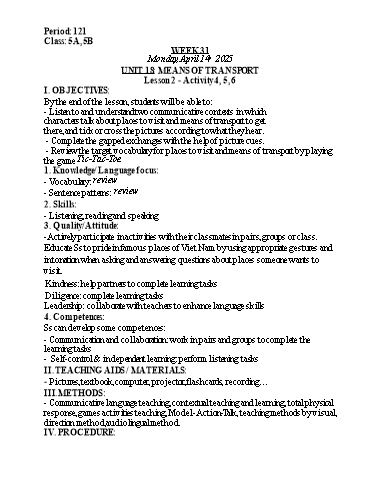
Period: 121 Class: 5A, 5B WEEK 31 Monday, April 14th 2025 UNIT 18: MEANS OF TRANSPORT Lesson 2 - Activity 4, 5, 6 I. OBJECTIVES: By the end of the lesson, students will be able to: - Listen to and understand two communicative contexts in which characters talk about places to visit and means of transport to get there, and tick or cross the pictures according to what they hear. - Complete the gapped exchanges with the help of picture cues. - Review the target vocabulary for places to visit and means of transport by playing the game Tic-Tac-Toe. 1. Knowledge/ Language focus: - Vocabulary: review - Sentence patterns: review 2. Skills: - Listening, reading and speaking 3. Quality /Attitude: -Actively participate in activities with their classmates in pairs, groups or class. Educate Ss to pride in famous places of Viet Nam by using appropriate gestures and intonation when asking and answering questions about places someone wants to visit. Kindness: help partners to complete learning tasks Diligence: complete learning tasks Leadership: collaborate with teachers to enhance language skills 4. Competences: Ss can develop some competences: - Communication and collaboration: work in pairs and groups to complete the learning tasks - Self-control & independent learning: perform listening tasks II. TEACHING AIDS / MATERIALS: - Pictures, textbook, computer, projector, flashcards, recording III. METHODS: - Communicative language teaching, contextual teaching and learning, total physical response, games activities teaching, Model-Action-Talk, teaching methods by visual, direction method, audiolingual method. IV. PROCEDURE: Teacher’s activities Students’ activities 1.Warm- up: 5’ - Game: Racing *Aims: to help ss to be happy and play game *Teaching techniques: - techniques in teaching playing game *Procedure: - Divide the class into three groups. Each - Ss listen. group has equal numbers of Ss. - Ask Ss to stand in lines. Set the timer. - Ask the first student from each line What’s your address? he/ she must answer and in turn ask the second student in the line. The second student then answers and asks the third, and so on. - The group which has the shortest time to finish asking and answering wins the game. - Have time for Ss to play game. -Ss play game. -Say “Open your book page 55 and look at -Ss open their book. lesson 2 – Activity 4, 5, 6” 2. New lesson Activity 1. - 4. Listen and tick or cross :9’ *Aims: to listen to and understand two communicative contexts in which characters ask and answer questions about the places to visit and means of transport to get there, and tick or cross the pictures according to what they hear. *Context: Picture cues: 1. National Park and a taxi 2. Tower Bridge and a bicycle *Audio script: 1.A: I want to visit somewhere this morning. B: Where do you want to visit? A: I want to visit to National Park. B: That’s a good place. Let’s go by taxi. 2.A: Excuse me. B: Yes. A: I want to get to Tower Bridge. How can I get there? B: Well, you can get there by bus. A: Thank you so much. *Teaching techniques - techniques in teaching listening -individual, pairworks, using recording, pictures *Procedure: - Have Ss look at the pictures, ask, “What -Look at the picture, listen and place can you see in each picture? What answer. means of transport can you see in each picture?” -Tell Ss to look at the Picture 1, then say that they will hear a conversation between a boy and girl about a place to visit and means of transport to get there. Ask Ss to tick the picture if it is correct, or cross if it is incorrect. Play the recording of the first conversation twice. - Play the recording for ss to do the task. -Ss listen and do the task - Get Ss to swap with a partner. -Ss swap. -Play the recording again to check answers -Ss listen and repeat. together as a class. -Ask ss to write their answers on the board -Ss write their answers and correct their answers. - T gets feedback. * Key: 1. ✔, 2. Activity 2 - 5. Read and complete:9’ *Aims: to complete the gapped exchanges with the help of picture cues. *Context: Two picture cues of places to visit and means of transport to get there - Two conversations with gaps to complete *Teaching techniques - techniques in teaching reading -individual, pairworks, pictures *Procedure: - Have Ss look at the pictures, ask, “What place can you see in each picture? What means of transport can you see in each picture?” - Tell Ss to look at the Picture 1, then say -Look at the picture and identify. that they will hear a conversation between a boy and girl about a place to visit and means of transport to get there. Ask Ss to tick the picture if it is correct, or cross if it is incorrect. Play the recording of the first conversation twice. - Model with a sentence. -Ss do the task. - Have Ss complete the sentences individually. Go around the classroom to offer support where necessary. -Ask ss to write their answers on the board -Ss write their answers and correct their answers. -Ask a few Ss to read the correct answers -Ss read in front of the class. in front of the class. -T gets feedback. * Key: 1. How; by bus 2. go to / visit; get; by boat Activity 3.- 6. Let’s play :7’ *Aims: to review target vocabulary for places to visit and means of transport by playing the game Tic-Tac-Toe. *Context:Two picture cues of places to visit and means of transport to get there - Two conversations with gaps to complete *Teaching techniques - techniques in playing game - individual, groupworks, using recording, pictures *Procedure: - Ask Ss to look at the pictures and identify the places to visit and means of transport to get there. -Ss look and listen. - Have Ss read Exchange 1. Ask them what is missing in the gaps. Have them complete the gaps by finding the clues from the context and the picture. Repeat the same procedure with Exchange 2. - Get Ss to complete the exchanges individually, then ask a few pairs to read the completed exchanges aloud. Check their answers, giving corrections and feedback where necessary. * Key: 1. How; by bus 2. go to / visit; get; by boat -Ss do the task. 4. Homelink .2’ - Practice more at home. -Ss listen. - Prepare for the next lesson. -Ss listen. *********************************** Period: 122 Class: 5A, 5B Tuesday, April 15th 2025 UNIT 18: MEANS OF TRANSPORT Lesson 3- Activity 1, 2, 3 I. OBJECTIVES: By the end of the lesson, students will be able to: - Correctly repeat two Yes / No questions with rising intonation. - Listen and say four Yes / No questions with rising intonation. - Say the chant with the correct rhythm, intonation and pronunciation. 1. Knowledge/ Language focus: - Phonic: Two Yes / No questions: Is it time for a trip? and Is it far from here? - Vocabulary: review - Sentence patterns: review 2. Skills: - Listening and speaking. 3. Quality /Attitude: Actively participate in activities with their classmates in pairs, groups or class. Educate Ss their pride in famous places of Viet Nam by using appropriate gestures and intonation when asking and answering questions about places someone wants to visit. Kindness: help partners to complete learning tasks Diligence: complete learning tasks Responsibility: appreciate kindness 4. Competences: SS can develop some competences: - Communication and collaboration: work in pairs and groups to complete the learning tasks - Self-control & independent learning: perform listening tasks II. TEACHING AIDS / MATERIALS: - Pictures, textbook, computer, projector, flashcards, recording III. METHODS: - Communicative language teaching, contextual teaching and learning, total physical response, games activities teaching, Model-Action-Talk, teaching methods by visual, direction method, audiolingual method. IV. PROCEDURE: Teacher’s activities Students’ activities 1.Warm- up: 5’ Game: Lucky number *Aims: to help ss to review the old lesson and be happy to learn new lesson. *Teaching techniques: -techniques in teaching playing game. *Procedure: - Teacher divides the class into 2 teams. -Ss listen - Each team takes turns to choose the -Ss play game. number and answer the question. - Teacher checks the answer with the whole class. - Ss get the point(s) if they answer the question correctly. - The team with more points is the winner. -Say “Open your book page 56 and look at -Ss open their book. Unit 18, Lesson 3- Activity 1, 2, 3” 2. New lesson Activity 1. - 1. Listen and repeat:10’ *Aims: To correctly repeat two Yes / No questions with rising intonation. *Context: - Two Yes / No questions: Is it time for a trip? and Is it far from here? *Teaching techniques - techniques in teaching listening and speaking, - individual, pairworks, ask and answer - using flashcards, recording, pictures *Procedure: -Look and listen. -Ask Ss to pay attention to the arrow indicating rising intonation at the end of the Yes/ No question Is it time for a trip? Have them listen to the recording and repeat the sentence until they feel confident. Correct their pronunciation and intonation if necessary. -Play the recording again and encourage Ss to listen and repeat. Do this a few times -Listen, point, listen and repeat. until Ss feel confident. Correct their pronunciation where necessary and praise them when their pronunciation is good. -Play the recording again and encourage Ss to listen and repeat. Do this several times until Ss feel confident. Correct their -Ss listen and repeat. pronunciation where necessary. -Have time for ss to practise in pairs. Go around the classroom to offer support if -Ss practise in pairs. necessary. - Call some pairs to act out in front of the -Ss practise in front of the class. class. - T corrects pronunciation, if necessary. -T gets feedback. Activity 2 - 2. Listen and repeat. Pay attention to the intonation:10’ *Aims: to listen and say four Yes/ No questions with rising intonation *Context: - Four Yes/ No questions *Teaching techniques - techniques in teaching listening, pairworks, ask and answer - using flashcards, recording, pictures *Procedure: - Have Ss read Question 1. Explain that they -Look at the picture and answer. will hear the question, then repeat with rising intonation. - Do the same with Questions 2 - 4. -Ss listen and do the task. - Invite a few Ss to say the questions in -Ss say the questions in front of the front of the class. Give corrections and class. feedback where necessary. -T corrects pronunciation, if necessary. -T gets feedback. * Key: 1. c 2. a 3. a Activity 3. Let’s chant :6’ *Aims: To say the chant with the correct pronunciation, word stress and rhythm. *Context: -The lyrics and recording of the chant *Teaching techniques - techniques in teaching chanting, groupworks, ask and answer - using flashcards, pictures *Procedure: - Draw Ss’ attention to the lyrics of the -Ss look and listen. chant. Check comprehension. - Play the recording all the way through for -Ss listen and chant. Ss to listen to the whole chant. Encourage them to listen carefully to the rhythm and pronunciation. - Play the recording, line by line, for Ss to -Ss listen and repeat line by line. listen and repeat. Correct their pronunciation if necessary. - Play the recording all the way through for -Ss chant and clap. Ss to chant. Encourage them to clap along while chanting. - Divide the class into two or more groups -Ss chant in groups. to take turns listening and repeating the chant. while the rest of the class claps along. -Have time for ss to chant in pairs. Go -Ss chant in pairs. around the classroom to offer support if necessary. - Call some pairs to read the chant in front -Ss chant in front of the class. of the class. - T corrects pronunciation, if necessary. *. Homelink. 1’ - Practice more at home. -Ss retell. - Prepare for the next lesson. Do exercise -Ss listen. U18. *********************************** Period: 123 Class: 5A, 5B Wednesday, April 16th 2025 UNIT 18: MEANS OF TRANSPORT Lesson 3- Activity 4, 5, 6 I. OBJECTIVES: By the end of the lesson, students will be able to: - Read a letter and show understanding by deciding if the sentences are true or false; - Write the answers to the guiding questions based on their personal information; - Present the results of a survey of Ss’ homes to the class. 1. Knowledge/ Language focus: - Vocabulary: review - Sentence patterns: review 2. Skills: - Listening, writing and reading 3. Quality /Attitude: Actively participate in activities with their classmates in pairs, groups or class. Educate Ss their pride in famous places of Viet Nam by using appropriate gestures and intonation when asking and answering questions about places someone wants to visit. Kindness: help partners to complete learning tasks Diligence: complete learning tasks Leadership: collaborate with teachers to enhance language skills 4. Competences: SS can develop some competences: - Communication and collaboration: work in pairs and groups to complete the learning tasks. - Self-control & independent learning: perform listening tasks. II. TEACHING AIDS / MATERIALS: - Pictures, textbook, computer, projector, flashcards, recording III. METHODS: - Communicative language teaching, contextual teaching and learning, total physical response, games activities teaching, Model-Action-Talk, teaching methods by visual, direction method, audiolingual method. IV. PROCEDURE: Teacher’s activities Students’ activities 1.Warm- up: 5’ - Game: Lucky numbers *Aims: to help ss to remember the chant. *Teaching techniques: - techniques in teaching chanting *Procedure: - Divide the class into two teams. - Ss listen. - The teacher prepares some cards (water park, pagoda, museum, lake, aquarium, island, on foot, by bus, by bicycle, by plane, by motorbike, by taxi) with random points on their backs (e.g. 10 / 20 / 30 points) and put them in a box. -Ss play game. - Have two Ss from each team come to the board alternatively. - One student picks up one card and asks a question matching the given card. e.g. Where do you want to visit? / How can I get to the museum? - Then his / her partner has to answer. - If the question and the answer are all correct, teams will get the points written at the back of the cards. - Continue the games with other teams. - The team that gets more points wins. -Say “Open your book page 57 and look at -Ss open their book. lesson 3- activity 4, 5, 6” 2. New lesson Activity 1. - 4. Read and answer :9’ *Aims: to read and understand a text about visiting Sydney and to answer the questions. *Context: A text from Mary to Linh about a city tour in Sydney – Four questions about the text *Teaching techniques - techniques in teaching reading -individual, pairworks, using recording, pictures *Procedure: - Set a time limit and ask Ss to read through the email to get a general idea of -Look at the picture, listen and it. answer. - Ask Ss to read Question 1. Encourage them to underline some keywords that can help them find the correct answer. Tell them to read the email again to answer the question. Do the same with Questions 2 - 4. -Have time for Ss to do the activity -Ss read and do the task. independently. Go around the class and offer help if necessary. -Ask Ss to swap their books with a partner -Ss swap. and check the answers. -Ask ss to check answers together as a -Ss check. class. - Ask ss to write their answers on the -Ss write their answers board. - T gets feedback and correct the answers. -Ss read aloud. - Call some ss to read aloud in front of the class. * Key: 1.Sydney Harbour Bridge and Sydney Opera House. 2. By train. 3. On foot. 4. Over 4,000 Activity 2 - 5. Let’s write :9’ *Aims: to write a paragraph about a morning trip using the picture cue. *Context: Picture cue: two Ss taking photos at an aquarium, and a bus parking outside it. - A gapped paragraph to complete *Teaching techniques: - techniques in teaching writing -individual, pairworks, pictures *Procedure: - Tell the class the goal of the activity. Ask -Look and listen. Ss to talk about what they can see in the picture. Give them prompts such as Where are they? What are they doing? What is behind them? and What is outside the building? Tell Ss that they should write about 40 words. - Give Ss time to do the task. Go around -Ss do the task. the classroom to offer support if necessary. - Get Ss to swap books with a partner, then check the answers together as a class. -Ss swap. - Ask ss to write their answers on the -Ss write their answers. board -T gets feedback and corrects the answer. * Key: Ss’s answer. Activity 3. - 6. Project :7’ *Aims: to make a presentation to the class about interesting places and how to get to them using various means of transport. *Context: A picture of a group of Ss giving their presentations *Teaching techniques - techniques in teaching base on project - individual, groupworks, using recording, pictures *Procedure: -Point at the photos of places and explain that Ss are going to present their photos of -Ss look and listen. some places to visit and means of transport to get there that they have prepared at home. - Revise some words and sentence patterns that Ss may use for their presentations. -Give Ss some time to practise their presentations by themselves and within -Ss do the task. groups. Go around the classroom to monitor and offer support. - Select a few Ss to give their presentations -Ss report their surveys in front of in front of the class. Give corrections and the class. feedback where necessary. 4. Homelink .2’ - Practice more at home. -Ss listen. - Prepare for the next lesson. -Ss listen. ********************************* Period: 124 Class: 5A, 5B Thursday, April 17th 2025 UNIT 19: PLACES OF INTEREST Lesson 1- Activity 1, 2, 3 I. OBJECTIVES: By the end of the lesson, students will be able to: - Understand and correctly repeat the sentences in simple communicative contexts in relation to the topic “places of interest” in which ss ask and answer questions about someone's opinion of a place - Correctly say the words and use What do you think of _____? - I think it's / they’re ... to ask and answer questions about someone's opinion of a place; - Enhance the correct use of What do you think of _____? - I think it's / they’re ...to ask and answer questions about someone's opinion of a place in a freer context. 1. Knowledge/ Language focus: - Vocabulary: beautiful, exciting, fantastic, peaceful - Sentence patterns: What do you think of _____? - I think it's / they’re ... 2. Skills: - Listening and speaking. 3. Quality /Attitude: Actively participate in activities with their classmates in pairs, groups or class. Educate Ss to gain appreciation for the diversity of human experiences and the value of preserving historical and cultural landmarks. Kindness: help partners to complete learning tasks Diligence: complete learning tasks Responsibility: appreciate kindness 4. Competences: SS can develop some competences: - Communication and collaboration: work in pairs and groups to complete the learning tasks - Self-control & independent learning: perform listening tasks II. TEACHING AIDS / MATERIALS: - Pictures, textbook, computer, projector, flashcards, recording III. METHODS: - Communicative language teaching, contextual teaching and learning, total physical response, games activities teaching, Model-Action-Talk, teaching methods by visual, direction method, audiolingual method. IV. PROCEDURE: Teacher’s activities Students’ activities 1.Warm- up: 5’ -Play game: Board race *Aims: to help ss to happy to play game. *Teaching techniques - technique in teaching playing game *Procedure: - Tell the Ss the goal of the game and how -Ss listen. to play it. Ask them to revise all vocabulary learnt in Unit 18. - Invite two groups of six Ss to the front of the class to play the game. Have two groups form two lines. -Ss play game. - Have Ss write all the words related to places and means of transport. - Give the Ss time to play the game. The groups with more correct words and pronunciation will be the winner. -Say “Open your book page 58 and look at -Ss open their book. Unit 19, Lesson 1- Activity 1, 2, 3” 2. New lesson Activity 1. - 1. Look, listen and repeat:9’ *Aims: To understand and correctly repeat the sentences in two communicative contexts (pictures) in which ss ask and answer questions about someone's opinion of a place *Context: – Context a: Lucy: Hi, Mai. It's a pity you didn't come to Ban Gioc Waterfall with us. Mai: I had to finish my project. Lucy: Oh, I see. – Context b: Mai: What do you think of Ban Gioc Waterfall? Lucy: I think it’s beautiful. *Teaching techniques - techniques in teaching listening and speaking, - individual, pairworks, ask and answer - using flashcards, recording, pictures *Procedure: -Set the scene: we are going to listen to the -Look at the picture and listen. dialogue in which the characters ask and answer questions about someone's opinion of a place. - Ask students to look at the picture in the -Ss look at the picture and identify book and identify the characters in the the characters in the pictures. pictures: + Who is he / she? + What are they talking about? - Play the recording again for Ss to listen -Ss listen and repeat sentence by and repeat in chorus, sentence by sentence. sentence. -Divide the class into two groups to read the -Ss read in groups. dialogue. -Have time for ss to point and read in pairs. -Ss point and read in pairs. T goes around the classroom to offer support where necessary. - Invite some pairs to practise in front of the -Ss practise in front of the class. class. - T get feedback. Activity 2 - 2. Listen, point and say:9’ *Aims: to correctly say the words and use What do you think of _____? - I think it's / they’re ... to ask and answer questions about someone's opinion of a place. *Context: - Picture cues: a: A picture of Ban Gioc Waterfall and the words Ban Gioc Waterfall / peaceful underneath b: A picture of Hoi An Old Town and the words Hoi An Old Town / exciting underneath c: A picture of the Petronas Twin Towers and the words the Petronas Twin Towers / fantastic underneath d: A picture of the Sydney Opera House and the words the Sydney Opera House / beautiful underneath – Speech bubbles: What do you think of _____? - I think it's / they’re ... *Teaching techniques - techniques in teaching speaking, pairworks, groupworks, ask and answer - using flashcards, recording, pictures *Procedure: - Teach vocabulary: beautiful, exciting, -Ss listen and repeat new words, then fantastic, peaceful (Using pictures) write on their notebook -Check vocabulary: matching -Ss play game. -Look at the picture and answer. - Sentence Pattern: -Ss listen and repeat. What do you think of _____? - I think it's / they’re ... - T models with a student. Then asks Ss -A student model. practice in pairs - Have time for Ss to practise in pairs and -Ss practise in pairs. corrects pronunciation if necessary. - Invite ss to ask and answer in front of the -Ss practise in front of the class. class. - T gets feedback Activity 3. Let’s talk :7’ *Aims: To enhance the correct use of What do you think of _____? - I think it's / they’re ... to ask and answer questions about someone's opinion of a place in a freer context. *Context: Picture cues: Ban Gioc Waterfall, the Petronas Twin Towers, the Sydney Opera House and Hoi An Old Town – Speech bubbles: What do you think of _____? - I think it's / they’re ... *Teaching techniques: - techniques in teaching speaking, groupworks, ask and answer - using flashcards, pictures *Procedure: -Tell Ss that they are going to practise more -Ss look and listen. with their friends to ask and answer questions about someone's opinion of a place in a freer context. - Elicit the words to fill in the gaps and have -Ss repeat. ss to repeat. -Have time for ss to practise in pairs. Go around the classroom to offer support where -Ss practise in pairs. necessary. -Call some pairs to act out in front of the -Ss act out in front of the class. class. - T corrects pronunciation, if necessary. -T gets feedback. *. Homelink. 1’ - Practice at home. Do exercise unit 18 -Ss listen. - Prepare for the next lesson. -Ss listen. ***********************************
File đính kèm:
- ke_hoach_bai_day_tieng_anh_lop_5_tuan_31_unit_18_unit_19_nam.docx
